Showing posts with label paper. Show all posts

9.17.2011

What can you do with your old newspapers? How about flip flops (or paperflops..)

Don't believe it? Check out Paperflops, flip flops that are made from entirely natural and biodegradable materials.This is not just a great idea, but also a great example of upcycling.

According to Paperflops, which is based in Indonesia, these Flip Flops are made of recycled and up-cycled newspapers. It takes approximately 1kg of old newspapers to produce a pair of PaperFlops Flip Flops. Other materials for the PaperFlop Flip Flops include root from old palm trees, coconut shells, and 100% natural rubber. The PaperFlop Flip Flops are quite durable and water proof since they are protected with a natural rubber sealant. 

Here are some more details about Paperflops from Ulule:

PaperFlops is a creative workshop that employs underprivileged people including street children and disabled people throughout Yogyakarta, Indonesia. This workshop trains and educates these people in arts and crafts to creating amazing products so they can be entirely self-sufficient.
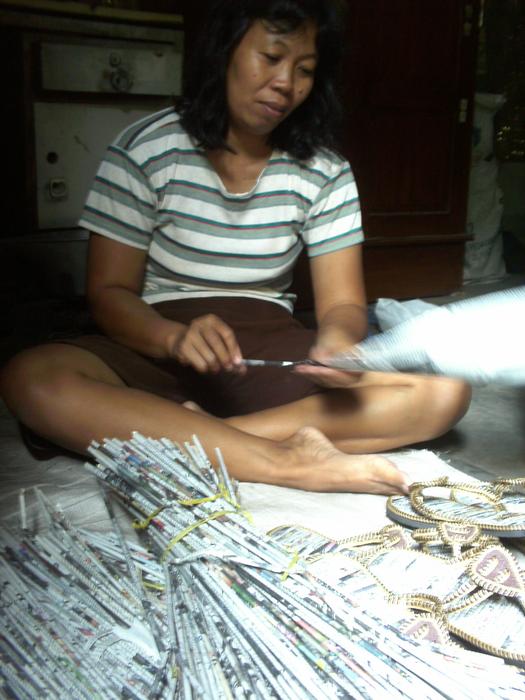


The workshop creates various unique handmade products made from recycled and up-cycled newspapers and other natural materials. All of the materials used in our workshop are environmentally friendly and sustainable. The products produced in our workshop include flip flops, sandals, bags, pencil boxes, and more.

The PaperFlops flip flops exist in different models and of course different sizes.It seems according to Ulule, where Paperflops were looking for funding couple of months ago, that their price is between $50-$60 including shipping, but it's not really clear where and how you can order them right now. If you want a pair, you might want to email Paperflops at thepaperflops@gmail.com to get more details.

Photos credit: Ulule


9.09.2011

My article on Triple Pundit on how Allstate reduced its paper use, saving both trees and money

Here's an update on a new article I published today on Triple Pundit on Allstate's achievement to cut its paper use internally by 41 percent and externally (customer focused reductions by eliminating unnecessary customer bill documents for example) by 12 percent, saving not just many trees but also a lot of money!

The article is entitled "Allstate Cutting Paper Use Drastically, Saving Both Trees and Money". Here's the first paragraph of the article: 

The insurance company Allstate uses a lot of paper – in 2009 it used approximately 3.7 billion sheets, equal to approximately 450,000 trees. So it’s not surprising that the company identified paper reduction as one of its top environmental priorities, setting a goal of reducing overall office paper use by 25 percent by 2010. In their latest CSR report, which was released earlier this week, Allstate is revealing that it actually did much better, reducing its office paper use last year by 41 percent.


To read the full article go to http://www.triplepundit.com/2011/09/allstate-cutting-paper-drastically-saving-both-trees-money/


Links to other articles I wrote for Triple Pundit can be found at http://www.triplepundit.com/author/raz-godelnik/

2.14.2011

Funny yellow pages photo!

(Source: Brand Constructors)

Actually it's a bit sad when you think about it..

Yours,
Raz @ Eco-Libris

Eco-Libris: Working to green the book industry!

2.01.2011

The State of Green Business 2011 - good news when it comes to paper intensity and recycling

Today, GreenBiz.com are publishing the State of Green Business report for 2011, which is defined as "their annual effort to take the pulse of what and how the world of sustainable business is doing." We simply call it the best report available on green business.

This report is looking into couple of issues that are related to our areas of interest, and this week we'll be looking into all of them, starting today with
paper.

The report, as Joel Makower chairman and executive editor of GreenBiz Group is writing today, includes mixed news, both good and bad developments in the green markets. Paper fortunately is one on the good side, presenting positive progress on two major fronts - paper intensity and recycling.

When it comes to paper intensity, we see a continuing trend of improvement. Paper intensity represents the amount of paper used per every unit of GDP (Gross Domestic Product). In other words, it shows how efficiently paper is used in the U.S. economy.
In terms of tons of paper per billion of dollars of GDP, paper intensity went down from 6.79 in 2008 to 6.13 in 2009. As you can see in the graph below (taken from the report, data provided by the American Forest & Paper Association), only couple of years ago we were in the range of 7-10, so this is definitely a significant improvement.

I guess it's not a big surprise to see this trend, especially when saving on paper is such a win-win strategy that help saving not just trees, but also a lot of money. Only last week the Environmental Leader reported that the "Bank of China’s London operations have reduced paper consumption by 95 percent with help from IBM", saving £12,000 a year on paper costs alone. I believe we'll hear more on companies that adopt similar practices (electronic routing and monitoring system in this case) to move one step further towards a more efficient and paperless office.

The big question of course is not what will happen in the US and Europe, where demand for paper will probably continue to decrease, but what will be with the demand in growing economies such as China and India. Will they use growing volumes of paper or use paperless leapfrog technologies
to promote their economic development.

When it comes to recycling we also see good results - The American Forest & Paper Association (AF&PA) reported that 63.4% of U.S. paper consumed was recovered in 2009. As you can see from the data they provide in the graph below, it continues a trend of growing recovery rate, and it is the first time this rate passed the 60%.

According to the report, "The American Forest and Paper Association, an industry group, estimates that once we reach about 80 percent over-all recovery, the remainder will be unfit for the reuse stream: Bath tissues and building papers alike pose challenges to recycling for both obvious and less obvious reasons." Even if it's true, I believe it makes more sense to find ways and technologies that will enable us to recycle (and even upcycle) more paper then to throw 20% of the paper volume to the trash. In any event, we're still far from reaching this ceiling and as the report explains there's still much to be done about recycling:

But there is still room for improvement, and while businesses have led the charge in making
the corrugated fibers that go into shipping products the most-recycled type of paper around, other areas of business use are lagging. For example, despite the seeming ubiquity of the blue recycling bin in offices nationwide, office and writing papers remain the least-recycled.

So good news about paper and we hope these trends will continue in the upcoming years, with or without the support of carbon regulation (hopefully with, as it will make it much simpler..). More updates from the State of Green Business report in the upcoming days. In the meantime, you can download the free report from GreenBiz.com.

Yours,
Raz @ Eco-Libris

Eco-Libris: Promoting sustainable reading!

12.13.2010

The Guinness World Records - how one ebook can save printing 1.15 billion pages a year?

I read some good news for the environment today: Chris Meadows reported on TeleRead that Guinness World Records was just published in an e-book edition, including "288 pages of 4,000 world records, including new and updated versions, as well as classic records."

Why it's good news for the environment? Because no matter how uncertain we are about the greenness of e-books (and we still are), there are some books that should be transformed to e-book format no matter what. Guinness World Records is one of them.

Now, don't get me wrong. I loved this book when I was a kid, but I'm not sure how many people still open the book to find information on these records at the age of the Internet. According to Amazon.com "Over 100 million copies have sold since the first edition was published in 1955. Nearly 4 million copies are sold every year in more than 100 countries and in 25 languages."

Quick calculation brings me to 1.15 billion pages that were printed for this book in 2010 alone. That's a lot of trees as well, which can be saved if this information will be available electronically. It's not just the fact that it's a thick book that makes it a good candidate for e-book format, it's also and mainly the fact that it's updated every year. In such situations, I believe that with the exception of libraries, it's a win-win-win for the consumers, the publisher and the environment to have this book only available as an ebook.

The eBook edition is published by Hachette Book Group, which also distributes the print edition.
Samantha Fay
, Senior Vice President of Sales and Marketing, Guinness World Records had this statement quoted on eBookNewser: “We are all excited at Guinness World Records to debut our first eBook in North America. We have watched the rise of the eBook market with interest, and in Hachette found the perfect partner to faithfully convert our complex and inspiring title so the 2011 Edition can be enjoyed for the first time in digital form.”

Well, I hope that we'll have many more years of interesting records, such as the longest banner flown by a helicopter (4,166.72 m²), collected by Guinness World Records and provided to us electronically with a new record of trees cut down to print the Guinness World Records - zero.

Yours,
Raz @ Eco-Libris

Eco-Libris: Promoting sustainable reading!